
PURPOSE
This policy details Leaders Institute’s (LI) principles and processes to protect children and young people from harm.
Scope
All staff, students, contractors, and visitors
PRINCIPLES
LI endeavours to safeguard children and young people by ensuring:
- government legislation and the Code of Conduct Policy are followed;
- the LI Head of Safety and Safety Officers at each campus publish after hours phone numbers;
- each campus has trained First Responders;
- this policy is included in student orientation and staff induction training;
- all LI representatives provide for and promote the care, protection, and wellbeing of children and young people;
- LI representative working with children or young people in an Institute-related activity undergo a “working with children” (or equivalent) check, including but not limited to employment, care, Work Integrated Learning, field study, or research;
- research undertaken with children or young people adheres to the Research Ethics Policy;
- child abuse allegations against LI representatives are reported to the relevant state authority and/or the police, except where the allegation is proven to be vexatious or false, as verified through the Complaints, Grievances, and Appeals Policy;
- any incidents or allegations relating to bodily harm adheres to the Critical Incident Management Policy;
- accurate records are permanently and securely maintained in accordance with privacy legislation.
DEFINITIONS
LI representative: all full-time, part-time and casual employees, contractors, visitors, researchers, and students.
Carer: an LI representative who is responsible for the care of a child or young person.
Child / young person: a person under the age of 18 years.
Child abuse: includes but is not limited to:
- any sexual offence or sexual misconduct, assault, ill treatment or neglect, exposing a child to behaviour that psychologically and/or physically harms a child; and/or
- accessing and downloading child pornography; and/or
- making inappropriate contact with people under the age of 18 via the Internet.
- Relevant state authority: the state or territory department responsible for child protection.
Harm: any negative impact on a person’s physical, emotional, psychological, social or developmental wellbeing, this includes both actual harm and the likelihood of harm but is not limited to abuse.
PROCEDURES
Permission must be sought from the Head of Safety or relevant Campus Manager before bringing children into LI teaching environments (including online) or office spaces. Due consideration must be given to requests to bring children or young people onto campus.
If permission is granted:
- a carer must always accompany and supervise children and young people;
- a carer should take all reasonable steps to safeguard the health and safety of the children or young people in their care (online or on campus);
- children and young people will not be permitted to access areas of LI that are hazardous or inappropriate;
- LI representatives will not be expected or required to supervise a child or young person of a carer.
Children and young people are not permitted to be on campus or present during online classes on a regular basis in lieu of childcare. Children and young people must not disrupt others or any LI activity, if this occurs and the child or young person becomes unreasonably disruptive, the carer and child or young person may be asked to leave the environment (campus or online).
REPORTING CONCERNS
LI representatives report concerns when:
- a child or young person discloses they have been or are at risk of being abused;
- someone else (regardless of age) discloses that they know of a child or young person who has been/is at risk of being abused;
- there are concerns that the child or young person may have been or is at risk of being abused based on their physical appearance or behaviour.
Flowchart for Reporting Concerns
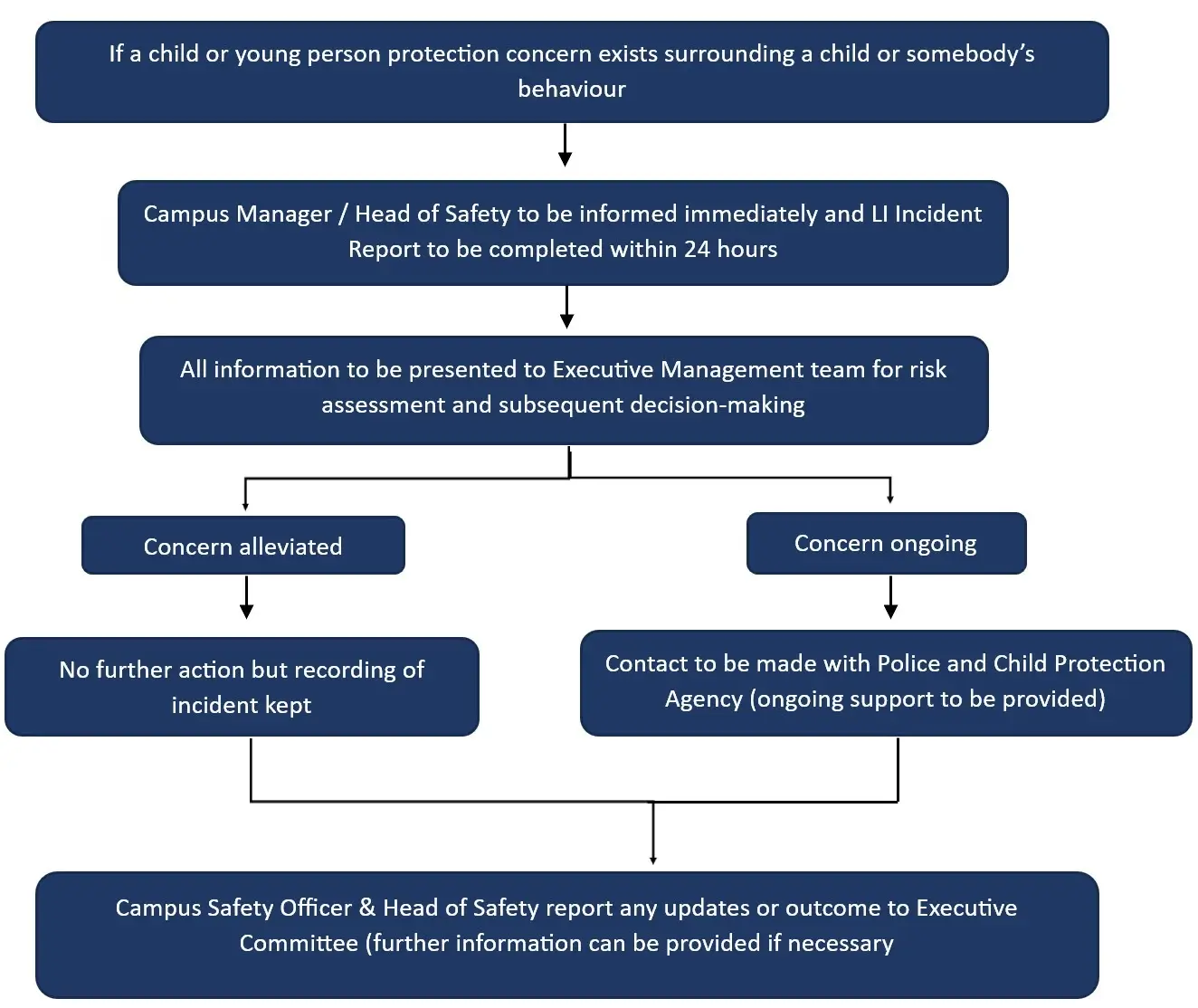
Note: if the Head of Safety or campus Safety Officers are not available, the abuse is currently occurring, or if there is reason to believe a child or young person is at risk, a report should be made immediately to police and relevant state authority. LI will suspend action if it is believed this will interfere with any police or state authority investigation, if no interference is suspected, the matter may be dealt with under LI’s grievance procedures.
Recording of Incidents
LI will automatically retain an anonymous report on the LI Incident Register; however, this may limit further action LI is able to take if there is limited or no information to identify involved parties. Any incidents relevant to this policy will be recorded on the LI Incident Register by the Health and Safety Officer. This register is inaccessible to staff.
Working With Children Check Procedure
Management, in partnership with Human Resource Department, should establish whether a Working with Children Check (WWCC) is required prior to advertising or recruiting for a role. If required, this should be included in the role description and advertisement. Prior to commencing, the new employee must provide valid WWCC documentation, this will be stored on their employee file. The Health and Safety Officer will check currency of this documentation at least once per quarter.