
PURPOSE
This policy outlines how research undertaken at Leaders Institute (GLI) by academic staff, Higher Degree Research (HDR) students and postgraduate research students complies with the National Statement on Ethical Conduct in Human Research 2025 (National Statement) and the Australian Code for the Responsible Conduct of Research.
SCOPE
All academic staff, HDR students, and postgraduate research students.
PRINCIPLES
GLI has a Memorandum of Understanding (MOU) with an external, registered Human Research Ethics Committee (HREC), Christian Research Association, for all research at GLI deemed from low to high risk. The body exists to help students and staff undertake human research ethically and will not comment on the methods or content of the research where that has no bearing on the ethics of the research.
GLI ensures that:
- all HDR students, Masters capstone students and academic staff undertaking human research complete research ethics induction prior to commencement of the research.
- professional development workshops on research ethics are provided for Research and Scholarship Committee members, academic staff, HDR students, and Masters capstone research students;
- all human research proposals are submitted to the external HREC to assess foreseeable levels of physical, psychological, social, economic or legal harm or discomfort. This includes, but is not limited to research methods, such as:
- surveys, interviews, or observations;
- medical or psychological testing;
- accessing personal documents, data, biological specimens, or tissue;
- human research is justified by its potential benefits to knowledge and understanding, to improved social welfare and individual wellbeing, and by its alignment to the Code of Conduct Policy;
- utmost care is taken to avoid any risks of harm, and the rights, dignity, health, safety, and privacy of participants are respected;
- human research is conducted in ways which involve respect for the welfare, beliefs, perceptions, customs, culture, and religious heritage of individuals and communities. This includes adherence to the First Nations Peoples Policy;
- human research is conducted in ways where:
- rights of participants regarding privacy and confidentiality are respected;
- any risks of harm are minimised;
- participants are informed of potential risks and benefits;
- participants make their own decisions about their involvement;
- human research with minors must have approval of the participants and their guardians.
HUMAN RESEARCH ETHICS
Human research undertaken by GLI’s academic staff, HDR students, and postgraduate research students complies with the National Statement and Australian Code for the Responsible Conduct of Research.
GLI ensures that:
- human research is justified by its potential benefits to knowledge and understanding, to improved social welfare and individual wellbeing, and by its alignment to the Code of Conduct Policy;
- any risk of harm is minimised and participants are informed of the potential risks and benefits. Participants make their own decisions about involvement;
- human research with minors is conducted with the approval of the participants and with the approval of their guardians. Utmost care is taken to avoid any risks of harm, and the rights, dignity, health, safety and privacy of participants are respected;
- human research is conducted in ways which involve respect for the welfare, beliefs, perceptions, customs, and cultural and religious heritage of individuals and communities, and people’s right to privacy and confidentiality are respected;
- human research proposals are assessed by Research and Scholarship Committee as to foreseeable levels of physical, psychological, social, economic or legal harm or discomfort according to GLI’s human research risk categories.
Ethical misconduct can be reported by staff to HREC which, upon investigation, may withdraw its approval for a project. Illegal activities in the context of research must be reported to the police.
Where projects have been approved by HREC, researchers must inform HREC of any major change to their research which may impact on ethical approval.
RESEARCH RISK CATEGORIES*
- GLI’s human research risk categories adhere to the National Statement:
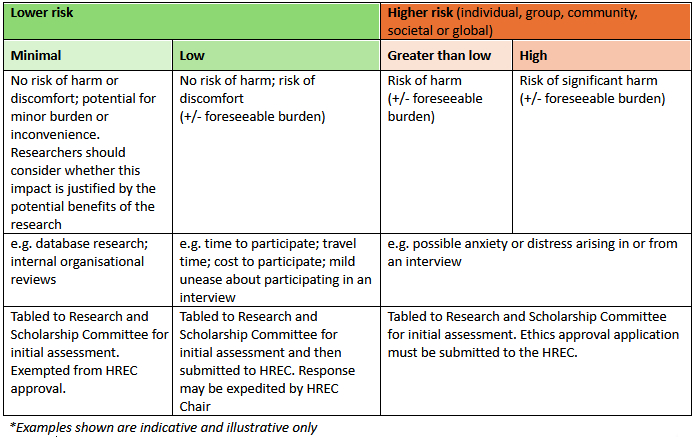
Participants in the lower risk categories are generally healthy adults (over 18 years old) who are:
- members of an Australian community, association, club, or institute of higher education;
- employees of an organisation who are not in an unequal power relationship with the researcher;
- invited to participate through a public advertisement or because they have a public position, which does not violate privacy legislation or compromise the voluntary choice of the participant;
- in non-identifiable data such as anonymous questionnaires or interviews;
- within research of non-sensitive issues unlikely to cause distress;
- not First Nations Peoples, people living outside of Australia, or people in marginalised communities.
All other human research is generally considered higher risk.
PROCEDURES
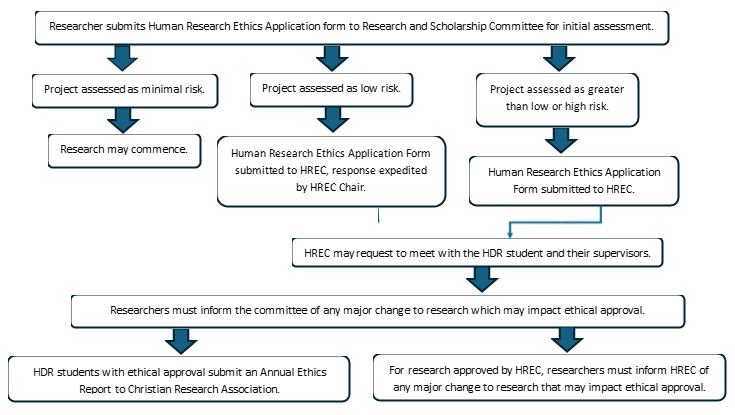
HUMAN RESEARCH ETHICS APPROVAL AND REVIEW
- For any proposed human research at GLI, the Christian Research Association’s Human Research Ethics Application Form is submitted to Research and Scholarship Committee for initial assessment.
- If assessed as minimal risk, the research may commence. If assessed as low risk, the Human Research Ethics Application Form is submitted to HREC, and the response may be expedited by the HREC Chair. If assessed as greater than low risk or high risk, the Human Research Ethics Application Form is submitted to HREC.
- HREC may request a meeting with the HDR student and their supervisors, so that questions can be resolved.
- Where projects have been approved by HREC, researchers must inform the committee of any major change to the research which may impact on ethical approval.
- HDR students with ethics approval submit an Annual Ethics Report to Christian Research Association.
- Where research has been approved by HREC, researchers must inform HREC of any major change to their research which may impact on ethical approval.
ACADEMIC AND RESEARCH MISCONDUCT
Information and/or evidence regarding alleged academic or research misconduct must be reported according to the Responsible Research Conduct Policy.
ETHICAL MISCONDUCT
Ethical misconduct can be reported by staff to Christian Research Association which, upon investigation, may withdraw its approval for a project. Illegal activities in the context of research must be reported to the police.
COMPLAINTS
Complaints by participants regarding the ethics of the research are addressed to HREC:secretary_HREC@cra.org.au. HREC considers and responds to the complaint.
Complaints by HDR students and Masters capstone research students regarding ethics approval follow the Complaints, Grievance, and Appeals Policy.
GLI academic staff grievances follow the Staff Grievance Policy.