
PURPOSE
This policy outlines the approach of Leaders Institute (LI) to resolving a complaint, grievance, or appeal involving a student, prospective student, member of staff, volunteer, or visitor.
SCOPE
Whole Institute. A complaint, grievance, or appeal by a staff member, as well as matters of sexual and gender-based misconduct are outside the scope of this policy.
PRINCIPLES
LI is committed to ensuring:
- transparent, ethical, and timely processes for addressing complaints, grievances, and appeals to which the principles of natural justice and procedural fairness are applied, regardless of campus or delivery mode of study;
- a management culture that prioritises and resources complaints handling, including regular training for staff;
- data analysis and student feedback are incorporated into reviews for continuous improvement;
- all relevant information about this is policy is advertised, clearly written, and easily accessible, including for students with diverse needs;
- confidentiality, equity and fairness are provided for all parties, without bias or special treatment;
- the right of all parties to have a support person present during meetings;
- adherence to current legal requirements;
- independent review of a decision determined in response to a grievance;
- there is no fee for complaint, grievance, or appeal processes;
- the complainant may seek confidential, independent professional advice at any stage of the process.
- the complainant may ask for assistance in the form of a translator/ interpreter at any time during the process;
- a student may continue their studies as usual during the process, except in circumstances where their health or safety is potentially at risk or if they pose a health or safety risk to others;
- all parties are kept informed of the progress and outcome decisions of their grievance or appeal;
- the complainant is kept informed of the progress and outcome decisions of their grievance or appeal;
- the complainant has the right to refer their grievance or appeal to an external agency.
Academic grievances and appeals : may include matters relating to:
- academic misconduct;
- assessments (including assignments, tests, exams);
- content and delivery of courses or units;
- advanced standing, cross credit or Recognition of Prior Learning (RPL);
- selection and admission into a course;
- special consideration;
- academic progress.
Administrative grievances and appeals : may include matters relating to:
- admissions;
- cancellation of enrolment;
- critical incidents;
- education agents;
- exclusion;
- facilities;
- fee payment and refunds;
- bullying, discrimination, harassment, or vilification;
- health, wellbeing, and safety;
- misconduct (other than academic misconduct);
- personal information;
- withdrawal without penalty.
LI will respond to any complaint, grievance, or appeal an international student makes regarding education agents or any related party LI has an arrangement with to deliver a course or related services.
DEFINITIONS
Academic decision or action
made by a LI staff member that is directly related to the academic progress of a student or prospective student. This may include but is not restricted to: an issue arising from application into or progression in a course; academic supervision; academic freedom; ethical practice; professional experience performance; quality of assessment feedback; or course workload.
Appeal
application made by a student or prospective student to have a decision reviewed where that decision relates to a matter affecting an experience at LI.
Authorised Officer
a relevant LI staff member with authority who may be approached at any time in relation to the policy, process, and implications of making a grievance or appeal. This may include, but is not limited to, an Administrative Officer, Campus Manager, Marketing Officer, Program Director, or Registrar.
Complaint
informal or formal concern or dissatisfaction lodged by a complainant about an experience at LI that requires review, investigation and/or action, and that is drawn to the attention of the Institute.
Complainant
the person who lodged the complaint
Grievance
This has the same meaning as a complaint, with understanding that a grievance is more serious and substantial.
Natural justice principles
Broadly summarised as follows:
- all parties to the matter(s) in dispute, including respondent(s) will have a right to be heard before a decision is made, including the right to respond to any statements or evidence that may prejudice their case;
- all relevant submissions, information, and evidence to be considered by the decision maker should be disclosed, where requested, to all parties to the complaint prior to the hearing. Matters that are not relevant shall not be considered by the decision maker;
- the decision maker/s shall not be biased or appear to be biased (by a reasonable and informed bystander) nor have a vested interest or personal involvement in the matter being considered;
- in addition to these principles of natural justice, there should be no undue delay in responding to complaints or appeals and all parties to such matters under this policy shall have the right to a representative of their choice, other than a currently practising solicitor or barrister (except in extraordinary circumstances at a hearing with the prior leave of the Chair of the Grievance Appeals panel).
Non-academic decision or action
A decision/action made by an LI staff member that is not directly related to the academic assessment or progress of a student or prospective student. It may include but is not limited to: customer service and administration; marketing and information; facilities; fees/finance related matters; or health and wellbeing.
Non-academic decision or action
A decision/action made by an LI staff member that is not directly related to the academic assessment or progress of a student or prospective student. It may include but is not limited to: customer service and administration; marketing and information; facilities; fees/finance related matters; or health and wellbeing.
Vexatious complaint
Complaints or grievances which are considered without merit, malicious or already resolved.
STUDENT SUPPORT
LI ensures that students are supported throughout the complaints, grievances, and appeals processes. Students may phone, email or present in-person to make anonymous or confidential complaints. The complainant is informed of how anonymity or confidentiality may impact the investigation, consideration or outcome of their complaint. Students are also welcome to seek other available external avenues of complaint resolution.
Complainants and respondents who require support through a complaint process are referred, or receive provider-facilitated referral where appropriate, to suitable support services. During the formal complaint process, complainants and respondents are provided with updates on the progress of a case at agreed intervals. This includes managing the complaint, outcomes, rationale for decisions, and further avenues for appeal or review. Decisions about formal complaints are promptly communicated to all parties in writing, subject to privacy obligations.
STAFFING
LI ensures that sufficient staff are trained across all delivery sites and modes to manage complaints, prepare responses, and retain currency in trauma-informed and person-centred practice. The early resolution of complaints is supported through triaging and appropriate empowering of staff with responsibilities to handle grievances and complaints.
Providing adequately trained staff across delivery sites and modes ensures that transfer of complaints casework between staff is minimised. Appropriate mitigations and supports are in place to respond to the wellbeing and safety needs of staff handling grievances and complaints and action is taken to address underlying risks.
GRIEVANCE APPEALS PANEL
The Chair of the Grievance Appeals Panel is appointed by the President. Membership includes:
- Registrar;
- at least one academic staff member (not associated with the grievance/appeal);
- at least one administrative staff member (not associated with the grievance/appeal);
- a nominee from the Student Representative Group, who cannot act as an advocate for the student or prospective student.
The Panel will meet on an as needs basis. Any conflict of interest must be declared, and that panel member must withdraw from the appeal hearing.
INDEPENDENT EXTERNAL APPEAL
Where the complainant has exhausted all internal grievance and appeals processes in this policy and remains dissatisfied, the complainant can access an external appeal process outlined below at no cost.
MONITORING, REVIEW AND IMPROVEMENT
Analysis of de-identified complaints data is tabled to Executive Management Committee and Governing Board every six (6) months to ensure the wellbeing of all involved. The data also identifies trends, causes, responses, and actions taken to improve support services and accountability. Any potential barriers to making complaints are identified and reasonable steps are taken to minimise or remove these barriers.
As noted in the Policy Development and Review Policy, monitoring, review and improvement of student grievance and complaint mechanisms are routinely undertaken annually. Comprehensive reviews are also completed on a five yearly basis. Students who engage with formal complaints services as a complainant or respondent are invited to provide feedback on their experience.
PROCEDURES
A student or prospective student is entitled to continue their enrolment or application while an internal review or appeal process is ongoing. However, the student or prospective student is not entitled to enrol in units which are the subject of or consequential to the decision under review and cannot withdraw from a unit with ‘special circumstances’ while the internal review or appeal process is ongoing if this unit is the subject of the decision under review or appeal.
Where a complainant remains dissatisfied with the decision, they are entitled to continue to the next step in the procedures, providing new or additional information is provided to support the case. It is not sufficient to simply disagree with the decision. Any student or prospective student who provides false or misleading information will have their complaint, grievance, or appeal application deemed invalid and may be dealt with in accord with the Academic Integrity Policy or Responsible Research Conduct Policy.
Any student or prospective student who makes a vexatious grievance may be dealt with under the Code of Conduct Policy.
The right to make a complaint, grievance, or appeal under does not affect the rights of the student or prospective student to act under the Australian Consumer Law if the Australian Consumer Law applies. A complainant may choose to have their grievance reviewed by an external appeal process. In this situation, LI will not continue further consideration of matters where the process options have been exhausted or where the complainant has taken their grievance to an external agency.
The procedure for the notification and resolution of a grievance related to sexual and gender-based misconduct is outlined in LI’s Sexual and Gender-Based Misconduct Prevention and Response Policy.
International Students
For international students studying in Australia where the grievance relates to them being excluded from a course due to not completing their course in the required time frame, not achieving satisfactory attendance, or not making satisfactory course progress, the student will be notified in writing that they will be reported to the Department of Home Affairs and this may result in their student visa being cancelled. The student will be informed, in writing, that they have 20 working days to access the appeals process.
LI will respond to any complaint, grievance, or appeal an international student makes regarding education agents or any related party with which LI has an arrangement to deliver the international student’s course or related services. If the international student submits a Complaints, Grievances and Appeals Form, this will be sent to the relevant Authorised Officer (usually the supervisor of the academic or administrative staff member involved in the grievance). If the grievance or appeal relates to a LI Education Agent, the submitted form will be sent to the LI Marketing Manager.
Complaints, Grievances, and Appeals Resolution Process
A person lodging a complaint, grievance, or appeal is expected to follow the resolution process below:
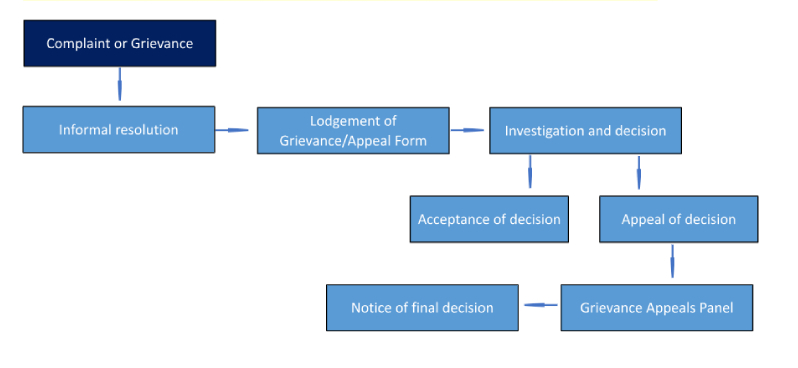
- Informal Resolution
- A person who has a complaint or grievance should, where possible, discuss this with the relevant LI staff member responsible for the academic or non-academic decision or action. The LI staff member will deal with the issue promptly and, where possible provide the person with a full explanation in writing of reasons for the decision or action with a view to avoiding an escalation of the grievance;
- If there is a conflict of interest, the staff member should refer the complaint or grievance to their supervisor;
- Most complaints and grievances should be resolved informally.
- Lodgement of Grievance and Appeal Form
- If a complaint or grievance cannot be resolved informally, the grievant may submit a Complaints, Grievances and Appeals Form with the relevant Authorised Officer (usually the supervisor of the staff member involved in the grievance);
- The complainant must provide the following:
- nature of the grievance;
- what actions they have taken to resolve the matter to date;
- evidence to support their claim;
- outcomes they are seeking.
- The person lodging the complaint or grievance is issued, in writing, with an acknowledgement of receipt of the grievance and advised of the timeframe for review of the grievance matter within five working days.
Any grievance which is anonymous and may allege or involve abuse of a minor or is a protected disclosure of alleged corruption or wrongful conduct in the context of the Corporations Act 2001 (Cth) is reported immediately to the President (or other suitable Authorised Officer, where relevant).
- Investigation and Decision
- The person lodging the complaint or grievance is notified in writing of the outcome within 10 working days of lodgement of the original grievance and of their right to appeal the decision;
- The person is provided with a written statement, which includes a full explanation for the decision;
- The decision taken may include to:
- deem the grievance to be invalid.
- dismiss the matter on the grounds that the grievant has not presented sufficient evidence to justify the matter as a grievance.
- uphold the grievance and provide a decision based on the evidence, including any agreed actions.
- A report will be recorded by the Authorised Officer in the LI Register of Complaints, Grievances, and Appeals;
- If the person who lodged the complaint or grievance is not satisfied with the internal grievance decision, they can submit a Grievance and Appeals Form to appeal the decision.
- Appeal of Decision
- Formal appeals are to be made to the Grievance Appeals Panel by lodging a Grievance and Appeal Form;
- In lodging an appeal, the person must specify in writing the grounds for appeal and attach copies of all documents relevant to the appeal;
- The person lodging the appeal is expected to provide genuine reasons and any additional factual evidence in support of an appeal of a decision. The Institute will not alter a decision merely on the grounds that the person lodging the appeal disagrees with the decision. In applying for the review or appeal of a decision, the person needs to provide evidence that the decision in the first instance was an unreasonable one;
- The appeal of decision matter is then dealt with by the Grievance Appeals Panel as soon as practicably possible.
- Grievance Appeals Panel
- The Chair of the Grievance Appeals Panel will convene the Panel to discuss the matter within five working days of receiving the appeal, ensuring that members of the panel are not those who have previously dealt with the grievance, and are experienced in the area of concern;
- The person lodging the appeal is provided an opportunity to formally present their case to the Panel and bring a support person to the Panel hearing;
- The decision of the Panel is the final internal decision and a formal report will be prepared within five working days after the Panel meeting;
- The Panel may take any of the following actions:
- deem the appeal to be invalid;
- dismiss the appeal on the grounds that the decision taken was right and proper, and/or the appellant has not presented sufficient evidence to justify further consideration of the appeal; and in so doing affirm the decision in its original form;
- uphold the appeal after establishing that there is sufficient evidence to support the finding that the decision taken was unreasonable.
- Where an appeal has been rejected by the Panel on the grounds of it being found to be invalid or lacking in sufficient evidence to justify further consideration, there is no further internal avenue for the appellant to appeal.
- Notice of Final Decision
- The Panel Chair provides written notice of the decision to the person lodging the appeal. It includes a statement of reasons for making the decision, as well as notifying them of their right to lodge an external appeal if they are unsatisfied with the decision;
- The Chair of the Grievance Appeals Panel will also detail if any corrective or preventative actions are to be taken by the Institute because of the decision.
INDEPENDENT EXTERNAL REVIEW
If an internal review request is dismissed, or the complainant is unsatisfied with the outcome of the internal review, there are no further avenues available within LI. All independent external reviews for student complaints are managed by the National Student Ombudsman (NSO), an Australian Government agency. The NSO is a free and independent service for all higher education students in Australia.
Students should contact the NSO for complaints or grievances relating to:
- student safety and welfare, including gender-based violence;
- course administration, such as timeliness and accuracy of information provided to students;
- teaching provision and facilities, such as sufficiency of staffing to meet educational, academic and administrative needs of students;
- disciplinary processes, such as procedures to address misconduct;
- reasonable adjustments for students with disability or experiencing special circumstances.
Both LI and the international student or prospective international student are bound by the decision of the ombudsman, and such decisions are final and non-reviewable. While the appeal is still being investigated, an enrolled international student may continue to attend classes as normal unless the student has a reasonable concern about an imminent risk to their health, wellbeing, or safety.
Information regarding the NSO’s services and procedures can be found at: National Student Ombudsman. A complainant should submit their request for an independent external review within 10 working days of receiving notice of the outcome of the internal LI process.
CONFIDENTIALITY
All documentation relating to grievances or appeals will be kept confidential and will be disclosed only to those persons who have a right to the information by virtue of their role in the review or appeal process, or as required by law.
REPORT
The Authorised Officer submits an annual report to Academic Board, Executive Management Team, and Governing Board that includes the number, nature and outcome of complaints and grievances, as well as any other relevant information (ensuring that all information is de-identified). This report highlights trends and addressing risk and quality issues.
In the case of a complaint or grievance taken to the NSO, the Authorised Officer reports to Academic Board, Executive Management Team, and Governing Board a summary of the issue, recommendations, and actions taken.